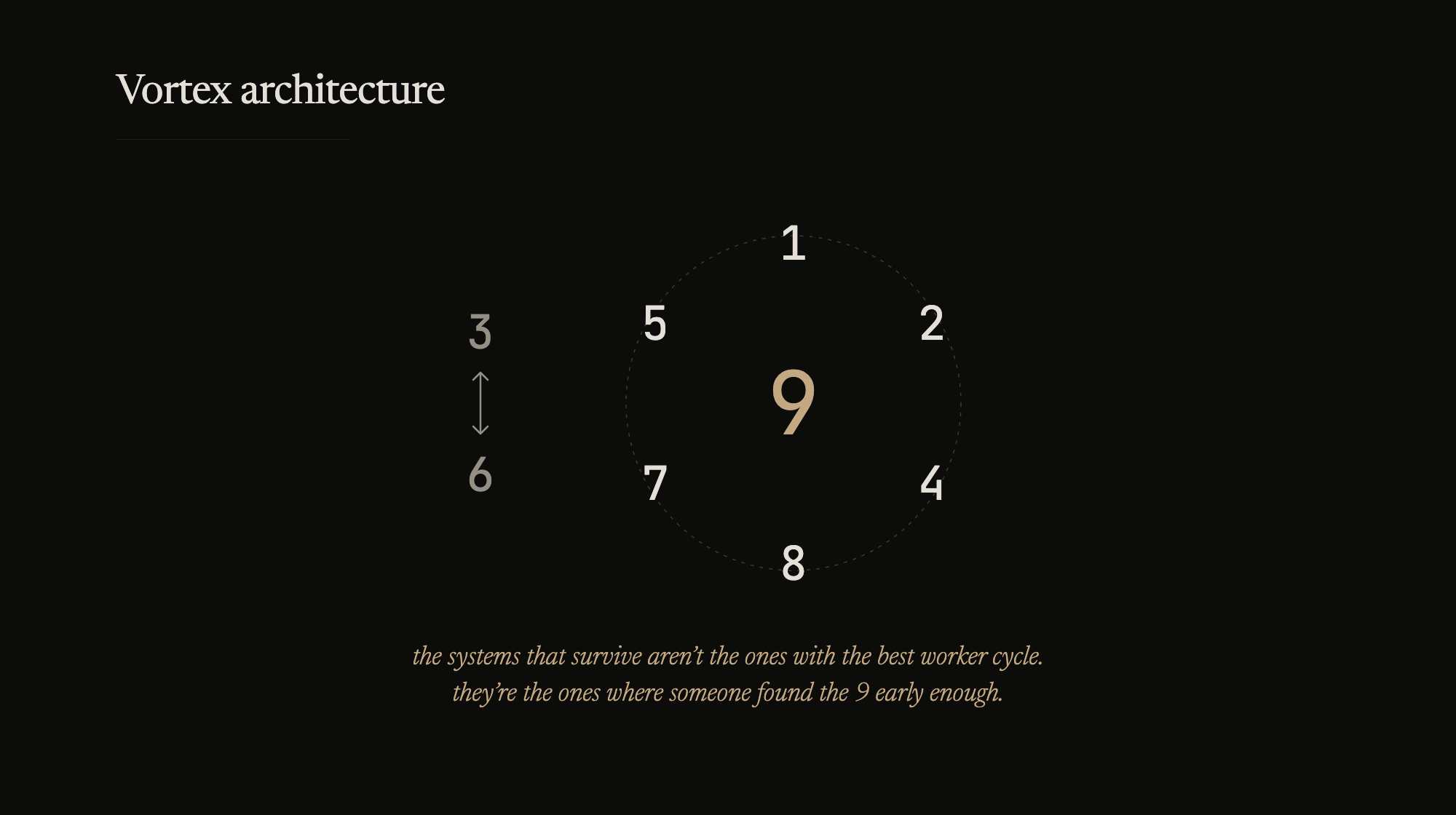
Tesla had this thing about 3, 6, and 9. “If you only knew the magnificence of the 3, 6, and 9, then you would have a key to the universe.”
Take any doubling sequence. 1, 2, 4, 8, 16, 32, 64. Reduce each to its digital root – keep adding digits until you get one number. You get 1, 2, 4, 8, 7, 5. Then it repeats. Forever. Six numbers doing all the motion, cycling endlessly.
3 and 6 never show up in that cycle. They oscillate between each other – 3 doubles to 6, 6 doubles to 12 which reduces to 3, back and forth. They govern direction without joining the motion.
And 9 just maps to itself. 9 times anything, reduce it, you get 9. It absorbs everything and stays unchanged.
The worker cycle – 1, 2, 4, 8, 7, 5 – feels like every operational layer I’ve ever built. Services scale, traffic doubles, data compounds, and at some point the problems repeat at a new order of magnitude. Same patterns, different zeros. You optimize, you double again, you cycle back. That’s where most engineering effort goes. Sprints live here.
The 3-6 oscillation feels like policy. Consistency and availability – you lean toward one, correct toward the other, and never stop oscillating. These don’t do the work, they set the direction.
And 9 – that’s the invariant. The schema contract that holds at 100x. The interface boundary you defined early that never needed changing. The architectural decision that aged well not because it was clever, but because it didn’t try to participate in the motion. It just held.
The systems that survive aren’t the ones with the best worker cycle. They’re the ones where someone found the 9 early enough.
Stop staring at the motion. Look for the thing the motion revolves around.
Turns out that’s decent architectural advice.