A friend of mine – college senior, the kind of person who turns a chai break into a two-hour philosophy session – once reframed Lord Shiva for me in a way I haven’t been able to shake.
Start with the surface. Long hair. Snake around the neck. A drum. Followers. Performance art that shakes the cosmos. Lives outside every social norm. Shiva might be the original rock star, and I’m not sure anyone’s topped the aesthetic since.
But that’s the entry point, not the idea.
The idea is the third eye.
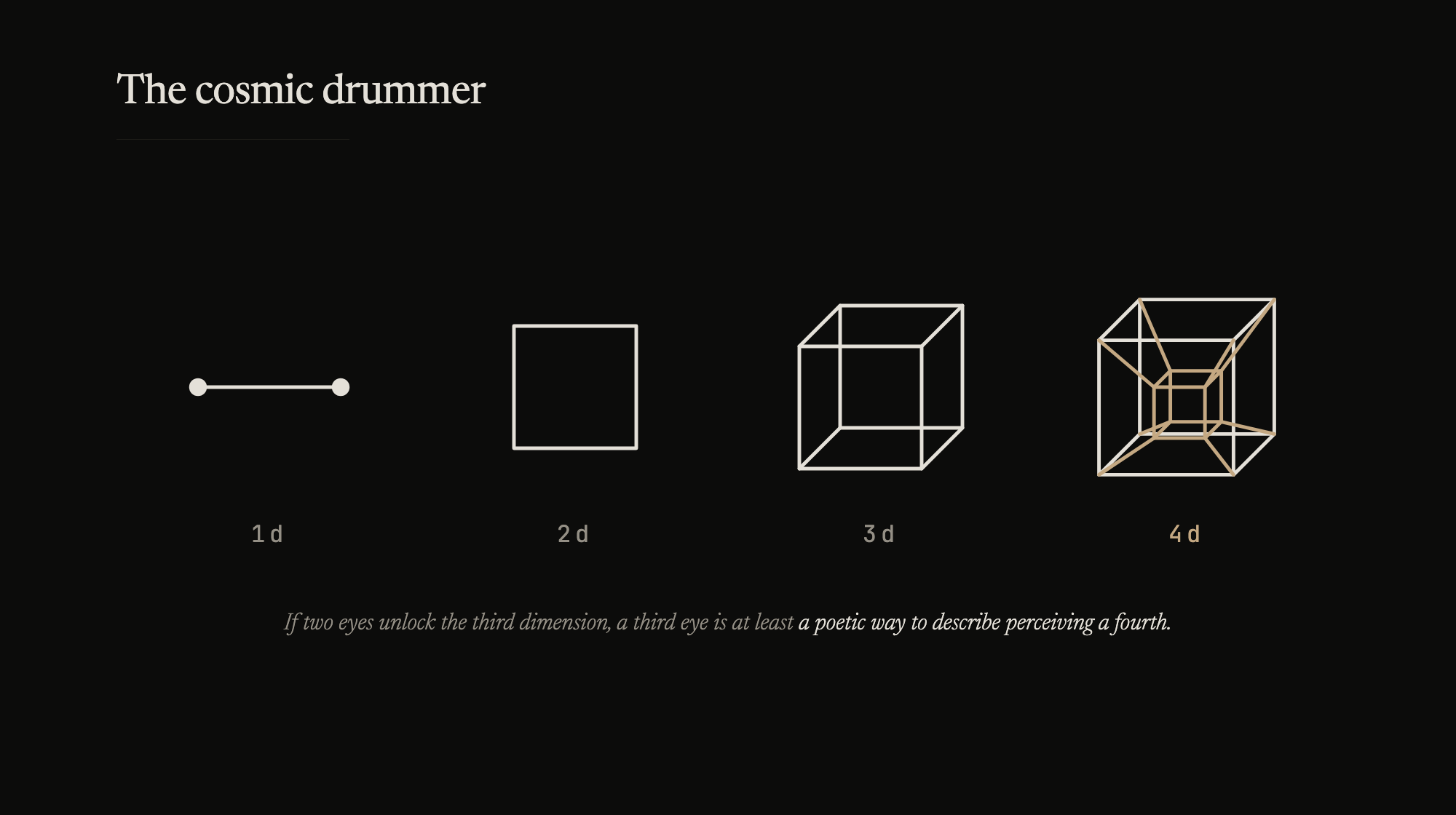
We see in three dimensions because we have two eyes. Binocular vision creates depth – parallax gives us the third axis. That’s geometry, not mysticism. So what does a third eye give you? If two eyes unlock the third dimension, a third eye is at least a poetic way to describe perceiving a fourth.
We can’t visualize four spatial dimensions. We can describe them mathematically – a tesseract is a 4D cube, and you can rotate one on a screen, but you’re watching a 3D shadow of a 4D object. You’re not seeing it. The way a circle drawn on paper is a 2D shadow of a sphere, but the paper doesn’t know what a sphere is.
The ancient texts call Shiva “trikaldarshi” – one who sees across past, present, and future simultaneously. That’s not prophecy. That’s what higher-dimensional perception would actually look like. A being outside our time axis, looking at our timeline the way we look at a line drawn on paper – all of it visible at once.
The tradition itself knows this. There’s a story where Vishnu and Brahma set out in opposite directions to find Shiva’s ends – top and bottom of an infinite pillar. They travel for uncountable years. They come back without finding the ends. Not because the pillar is very long. Because it doesn’t have ends the way a pillar does. अन्त देखि अनन्त – from end to infinity, the phrase in the old texts. A being whose boundaries are not in the same geometry as yours.
Then there’s the damaru – the drum. AUM, the primordial vibration that everything emerges from. String theory says the same thing in different language: fundamental particles are vibrations. Different frequencies, different particles. Reality as resonance patterns in higher-dimensional space. The ancients put a drum in the hands of the creator and said everything starts with sound. The physicists built particle accelerators and arrived at vibrating strings.
I don’t think the Vedic authors were doing quantum physics. But I don’t think the convergence is meaningless either. Different traditions of inquiry – one through meditation and symbol, one through mathematics and experiment – and they keep landing on similar shapes. Everything vibrates. Dimensions exist beyond perception. Destruction and creation are the same process viewed from different angles.
That last one is the Tandav – Shiva’s cosmic dance. Creation, preservation, destruction, not as a sequence but as a single continuous motion. We have a name for this in systems thinking: creative destruction. Old structures break down so new ones can emerge. The dance doesn’t stop between steps.
My friend’s point, the one that stuck: what if the mythology isn’t decorative? What if it’s compressed? Thousands of years of observation about the nature of reality, encoded in symbols that survived because they were wrapped in story and ritual rather than written as equations that would have been lost.
Maybe. Maybe not. The beauty of the question is that sitting with it is more interesting than answering it.