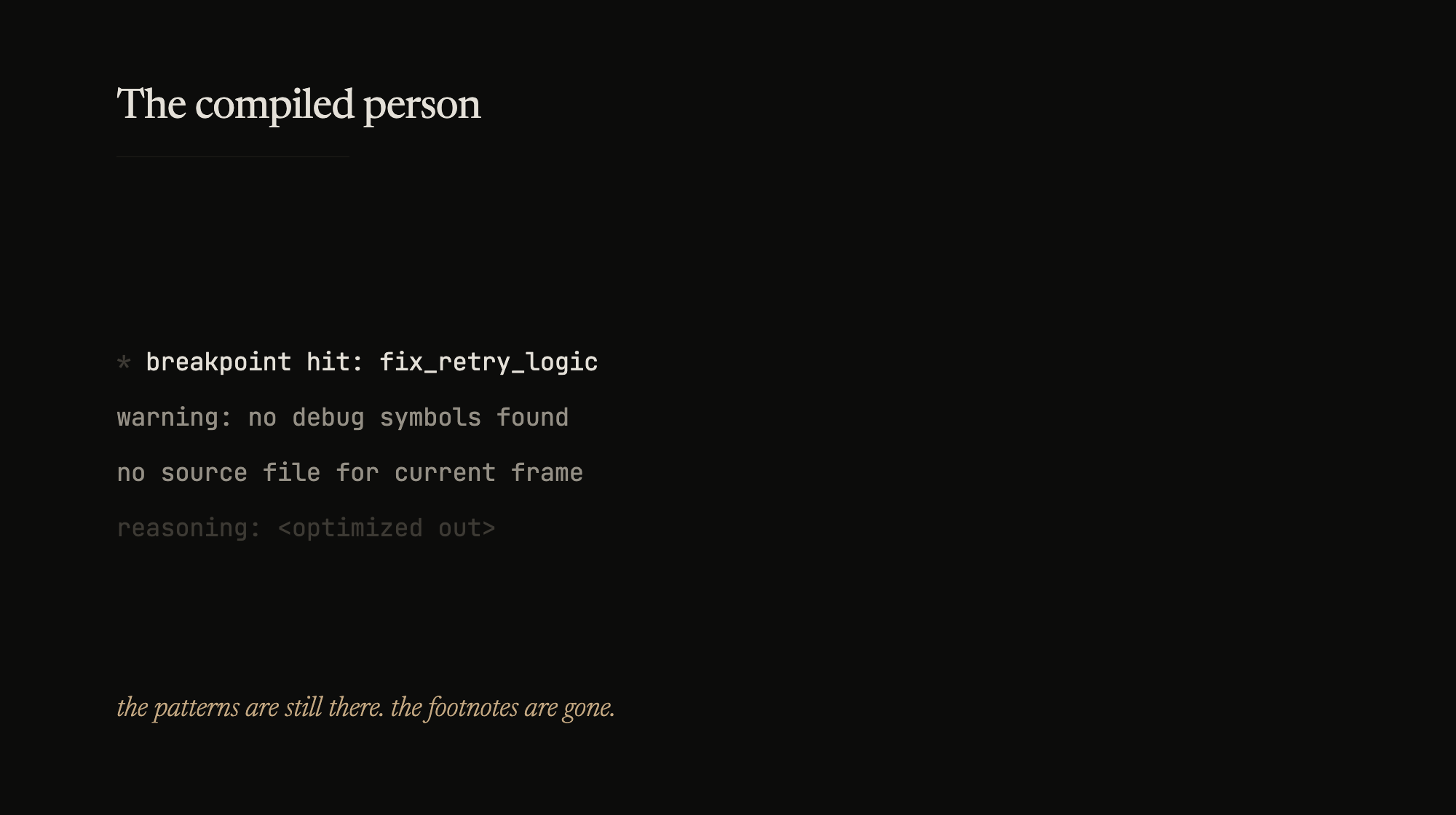
I stopped being able to explain why I knew. That’s how I found out I’d been compiled. The patterns still fire, the fixes still land, but the source files are gone. No debug symbols, no way to step through my own reasoning.
A junior asked me how I’d known the bug was in the retry logic before I’d even read the function. I’d skimmed twenty lines. The answer was somewhere in my head. I tried to retrieve it and got nothing. Just the conclusion. The shape was right. I couldn’t tell you which pattern fired or where I’d learned it.
For years I thought of expertise as accumulated. Books I’d read, mentors who’d corrected me, postmortems I’d written. All of it traceable. Somewhere along the way it collapsed into reflex. The book I read in 2014 became a way I look at retry loops. The senior who taught me to read tests first became something my eyes do automatically. The patterns are still there. The footnotes are gone.
I can fix this in ten seconds. I cannot teach you how.
It feels like gut feeling. It isn’t. Gut feeling has no history. Toddlers have it before they have words. We know more than we can tell. The compiled version is gut feeling with the source files lost.
That’s the cost. The compiled person is faster. Faster, and stuck. When the environment changes, the reflexes don’t follow. They keep firing the old way until something breaks. Sometimes the reflex matches on shape, not meaning, and I ship the wrong fix with full conviction. The reflex is also the bug.
The other cost is teaching. The junior who asks “how did you know?” deserves an answer. What I have is the conclusion, not the reasoning. I can show them the same bug fifty times and hope the same compilation happens to them. That’s not mentoring. That’s evidence.